

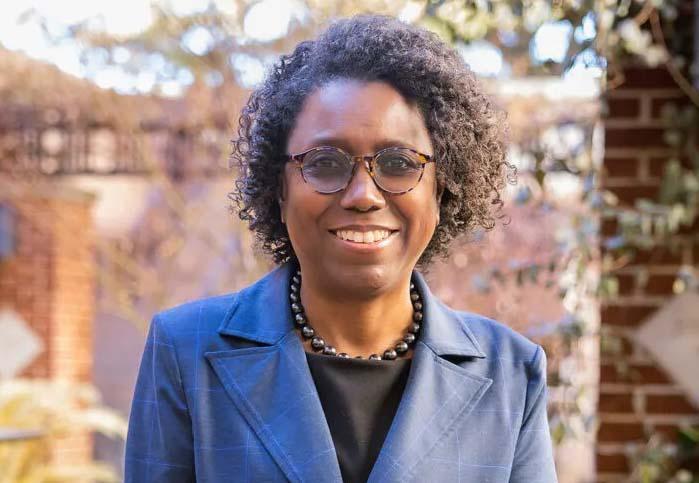
Dr. Stephanie Clintonia Boddie, Fuller Family Endowed Chair for Social Justice; Associate Professor of Church and Community Ministries
My journey into theology and sustainability did not begin in classrooms or formal doctrine. It grew from what scholars like Nancy Ammerman and Meredith McGuire call lived religion—faith formed through everyday practices, relationships, and embodied experience. More than a decade of undiagnosed illness led me to deepen my connection with God through creation: eating from the lush garden of my health coach and walking for hours in prayer. These became spaces of theological discovery. In the garden, I found a refugium—a place where life persisted, healed, and renewed itself amid vulnerability. There, I glimpsed the promise of Isaiah 58:11: God guides us continually, satisfying our needs even in scorched places, and makes us like a watered garden whose streams never fail.
I first shared these insights with children in a church garden, using the Parable of the Sower (Luke 8:4-15) to connect soil, care, and spiritual formation. This work grew into co-leading Bible Center’s Oasis Farm and Fishery, and later collaborating with Baylor colleagues, City of Waco staff, and community partners on the Sustainable Community and Regenerative Agriculture Project (S.C.R.A.P.), a community-based intervention and research initiative. Over time, I came to see congregational gardens and food projects as places of refugia, in the sense articulated by Debra Rienstra—spaces of shelter and renewal amid crisis. Here, faith takes shape where spiritual formation, ecological care, and social repair converge, and where kinship with creation is practiced rather than assumed.
Participation in the Common Home Fellowship represents a theological hope: that shared life, inquiry, and practice can form us more deeply for faithful engagement with God’s renewal. I anticipate gaining sustained opportunities for reflection with colleagues, deepening my understanding of how theology and sustainability intersect across disciplines, and bringing renewed insight, energy, and collaborative vision back to my course Education from a Gardener’s Perspective, for the benefit of both students and community partners. I envision this fellowship as a faithful refugium: a space where hope, humility, and kinship with creation are nurtured, and where together we are formed to participate in God’s ongoing work of restoration and flourishing. Through the life of this fellowship, I see Baylor strengthening its mission as a Christian university supporting faculty to advance interdisciplinary research and to equip students who live out faith through service, learning, and care for God’s creation.